
Researchers at the College of Veterinary Medicine, Washington State University and Washington Animal Disease Diagnostic Laboratory (WADDL) just published an article in the American Journal of Veterinary Research describing their experience testing sheep and goats for Johne’s disease for the period starting May 1, 2015, and ending June 1, 2024. This Open Access article is free to download. I have extensive comments after the abstract from this publication.
ABSTRACT
Objective:
To understand Mycobacterium avium subspecies paratuberculosis (MAP) diagnostic trends based on small ruminant submissions to the Washington Animal Disease Diagnostic Laboratory.
Methods:
Small ruminant MAP serum ELISA and fecal PCR results between May 1, 2015, and June 1, 2024, were obtained from Washington Animal Disease Diagnostic Laboratory. Prevalence estimates were established for goats and sheep relative to overall sample submissions, individual animals tested, and herds. Species-level differences in prevalence were evaluated based on ELISA manufacturer, age, sex, and breed.
Results:
A total of 108,092 small ruminant samples were submitted for MAP serum ELISA (n = 98,538 IDEXX Inc; 9,554 VMRD Inc) and 1,090 samples for fecal PCR. For sheep and goats combined, there was an overall 6-fold difference in positive prevalence between the 2 ELISA tests based on submissions (0.9% vs 5.8%), individuals (1.0% vs 5.8%), and herds (3.7% vs 24.2%). In comparison, combined fecal PCR results for sheep and goats indicated positive prevalences of 6.5% for submissions, 6.6% for individuals, and 11.2% for herds.
Conclusions:
This study offers valuable insights into the prevalence of MAP infection in domestic sheep and goats across the United States, the preferred diagnostic tests among producers and veterinarians, and variations in ELISA test characteristics.
Clinical Relevance:
The results highlight the poor alignment between small ruminant MAP diagnostic usage and recommendations to use ELISA tests primarily as a screening tool for control programs in MAP-infected herds with high prevalence (≥ 5% test positive) and fecal PCR or culture-based testing to enhance surveillance, eradication, or confirmation of Johne’s disease clinical diagnoses.
COMMENTS
I applaud the WADDL for publishing their experiences with testing goats and sheep for Johne’s disease. Diagnostic labs have a wealth of data to share and too few of them make the effort to do so as peer-reviewed scientific publications. This article creates what we in the academic world call a “teachable moment”. Hence, the extended comments below.
The WADDL study is observational, meaning “what you see is what you get”. The authors use the data to report the percentage of goat and sheep herds and individuals that tested positive for Johne’s disease over a 10-year period. They call this the “positive prevalence”. Ideally, this kind of data could be used to estimate the true (actual) prevalence of Johne’s disease, however, that requires a more precise and unbiased determination of the diagnostic sensitivity (percentage of MAP-infections detected by a positive ELISA) and diagnostic specificity (percentage of non-infected animals that test ELISA-negative). Estimates of these parameters by the ELISA kit manufacturer are hazardous to rely on, i.e. not unbiased.
Complicating interpretation of this data, the WADDL switched from one ELISA kit (IDEXX) to another (VMRD) in October 2023. Thus, over 89% of sample submissions were tested by the IDEXX ELISA kit.
From May 2015 to October 23, 1.6% of 8,589 goats 2 years and older and 3.4% of goat herds tested positive on the IDEXX ELISA. Then, from October 2023 to June 2024, 6.4% of 2,197 adult goats and 23.3% of goat herds tested positive when the lab switched to using the VMRD ELISA kit (see Table 2 of in the WADDL paper).
This begs the question:
- Did the rate of MAP infections in goats suddenly increase 4-fold,
or
- Was the VMRD kit more sensitive, i.e., better able to detect MAP-infected goats?
Unfortunately, the nature of the study design does not lend itself to answering this question. No data on parallel testing of goats by both the IDEXX and VMRD assays was provided. However, on a small subset of 77 goats, both ELISA and PCR testing was done and I’m exploring that data here for two reasons:
- The most common question received through the “ask an expert” feature of this website concerns goats and whether to trust a positive ELISA result, and
- It has direct bearing on how to interpret the “positive prevalence” data reported by the authors of the WAAVDL study. I have focused only on the goat results because too few sheep were tested by both types of tests and ELISA is notoriously poor for Johne’s disease diagnosis in sheep.
A total of 77 goats were tested by both ELISA and PCR. Unfortunately, some were tested using the IDEXX kit and some using the VMRD kit and the ages of the goats are not given. The summary data are illustrated in the 2×2 table below as is common when comparing two diagnostic tests.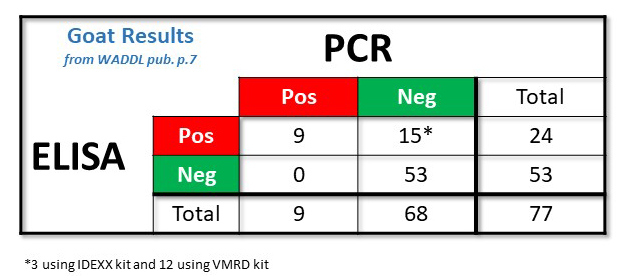
Test agreement –
For 9 goats the ELISA and PCR were both positive and for 53 goats the ELISA and PCR were both negative. Thus, 80.5% of the time the ELISA and PCR results agreed.
Test disagreement –
For 15 goats the ELISA was positive, and the PCR was negative. Objectively, there are two possible explanations: For each of the 15 goats, either, 1) the ELISA was false-positive (the goats were not actually MAP-infected) or 2) the ELISA result was correct and the goat was not shedding MAP in sufficient numbers to be detected in their fecal sample by PCR .
Examining these 15 test disagreements more closely, there was a difference in findings depending on which ELISA kit was used. The IDEXX kit (not validated* for goats) found only 3 of 24 total ELISA-positive goats (12.5%) to be PCR-negative while the VMRD kit (validated* for goats) found 12 of the 24 ELISA-positive goats (50%) to be PCR-negative. While some or all of these may be false-positive ELISA results or MAP infection detection before fecal shedding, the study design did not allow proof of which had occurred. To do so would require follow-up testing for at least a few years or necropsy of the animals involved. Importantly, however, it highlights that the ELISA is a screening test and cannot be used to definitively diagnose Johne’s disease. A PCR test on a fecal sample is required after a positive ELISA to confirm the diagnosis. The WADDL authors concur.
As stated previously, the most common question received through the “ask an expert” feature of this website concerns goats and whether to trust a positive ELISA result. Many times, these herds have no prior evidence of Johne’s disease and when I explain Johne’s disease testing to the herd owners I need to “talk them off the ledge” as they are so very concerned about the implications of the positive ELISA result for their animals. In my experience with such goat owners, when a fecal sample from the ELISA-positive goat is sent to a qualified lab, they most often find that the positive ELISA is not confirmed by PCR, just like for the 15 goats with test disagreement as reported by WADDL.
Pursuing an explanation after long conversations with goat owners, I have found that in many instances these owners also had backyard poultry that were in contact with the goats. It seems that exposure to chickens, and possibly other birds, can trigger a false-positive ELISA. Something associated with the birds seems to be triggering an antibody response in goats that is detected by Johne’s ELISA kits. I described the situation in one specific herd in a news item which you can find on this page of my website [scroll down] That owner had 5 goats with quite high ELISA values and yet all 5 were found to be PCR-negative. Being retired, I cannot pursue this intriguing observation with appropriate research and so encourage others to do so. In the absence of a definitive explanation, I urge veterinarians and goat owners to be aware of this conundrum and approach ELISA interpretation with caution, always asking about goat contact with poultry or other birds.
Published research (White et.al.) indicates that in MAP-infected goats, fecal shedding of MAP usually happens before the animals produce antibodies to MAP that are detectable by ELISA. A graphic from a MAP experimental challenge trial in goats illustrates the relative sensitivity of PCR, two ELISA kits and the AGID test for Johne’s disease over time.
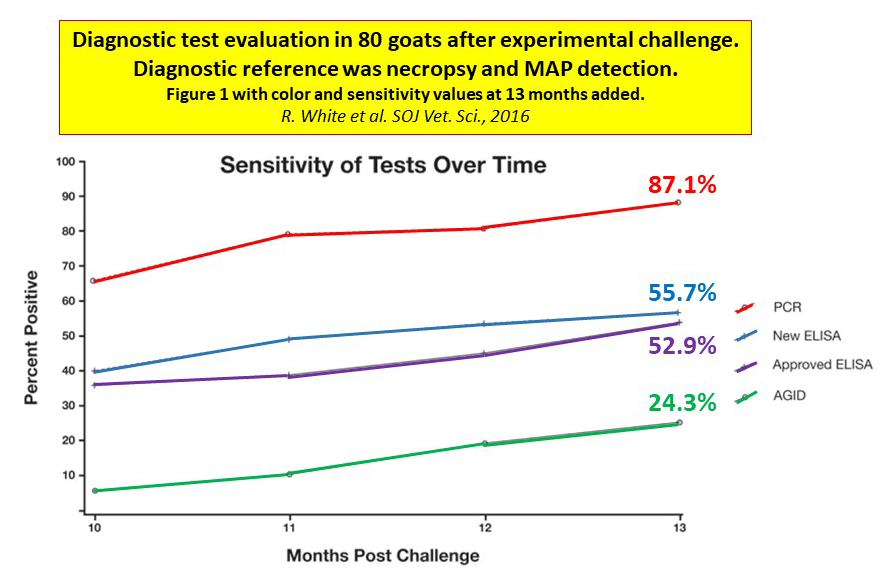
As you can see, from 10 to 13 months post-challenge (roughly ages 13 mo. to 16 mo. old in this trial), the PCR surpassed the ELISA kits in rate of MAP infection detection. At 13 months post-challenge (about 16 months old), the diagnostic sensitivity of PCR was 87.1%, the ELISAs were 52.9% and 55.7%, and the AGID was 24.3%.
Based on prior publications, such as the one by White, et.al., and my clinical experience as described in the news positing on this website titled “Goats and Chickens” (October 8, 2021), I suspect that many, if not most, of the positive ELISA results on goats that were fecal PCR-negative were false-positives. However, this can neither be proven nor disproven. However, the reality of this situation significantly affects interpretation of the “positive prevalence” data provided by the WVDL.
ELISA is a useful tool for screening some herds, particularly commercial dairy goat herds. However, for any herd owner selling animals for breeding purposes, I strongly recommend not using the ELISA but instead to use the fecal PCR for annual herd testing and surveillance for Johne’s disease. To control costs, I further recommend that goat breeders use laboratories that are USDA-approved to pool samples (most labs pool equal amounts of feces from 5 goats per pool). If a “pooled PCR” is negative, then all the goats in that pool are considered PCR-negative.
This is far more cost-effective than many people realize. For illustration, today the WVDL (Wisconsin, not Washington) charges $40.37/pooled PCR whether from in-sate or out-state owners). This equates to $8.07/animal. The ELISA cost at the WVDL is $6.92/animal which is essentially the same cost as the PCR if sample collection cost, i.e. blood collection tube and needle, are included in the total cost (Amazon price for both is $0.61). For most folks a veterinarian is required to draw the blood sample (and they seldom work for free). Of course, if a pooled PCR is found positive, then additional costs are incurred to test each of the 5 fecal samples making up that pooled sample at additional cost ($35.61/PCR at the WVDL). Therefore, pooled PCR is best suited for annual whole-herd testing for goat herds with a low or zero MAP infection prevalence.
Biosecurity is of paramount importance for goat breeders. Using PCR maximizes test accuracy at the animal and herd level providing a scientifically sound basis for animal trade while limiting risk of MAP spread within and among goat herds.
In summary, the fecal PCR for Johne’s disease:
- is more accurate, does not require a confirmatory test if positive,
- usually becomes positive before the ELISA (as the WADDL authors acknowledge), and
- is roughly the same cost as ELISA on a per head basis when done using sample pooling (the lab does the pooling).
Testing costs vary widely among laboratories. Some have different rates for in-state and out-of-state submissions, different accession fees (a fee per batch of samples), and differing requirements for a signature from a veterinarian on the sample submission form. So, goat owners should take time for some comparison shopping when choosing a testing lab. Also, it is wise to only use labs that are USDA-approved for the specific test of choice. A link to the USDA page listing approved labs by disease and test type can be found here. Once an owner selects the best lab for their needs, they should always use the same lab. As with all animal health issues, it is advisable to seek the help of your local veterinarian for control and eradication of Johne’s disease.
Clearly, carefully designed longitudinal studies on Johne’s disease in naturally MAP-infected goats using multiple diagnostic testing methods is needed to get precise, unbiased estimates of the diagnostic accuracy of available tests.
*Note: The reasons why some kits are “validated” for a specific species like goats is beyond the scope of this news post, but it is often a business decision revolving around the cost of test validation versus the size of the testing market. Thus, most all kits on the market today are validated for cattle but only some are validated for goats.