
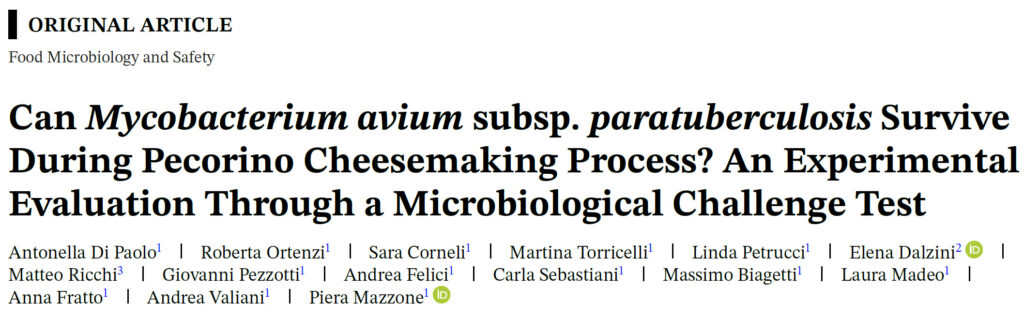
Di Paolo and her Italian colleagues describe experiments designed to assess if MAP can be killed by pasteurization during the production of Pecorino cheese. Their findings were recently reported in the March 14, 2026 issue of the Journal of Food Science. Pecorino romano is a hard, salty Italian cheese made from sheep milk, often used for grating over pasta or other dishes. The name pecorino means “ovine” or “of sheep” in Italian; the name of the cheese, although protected, is a description rather than a brand (Wikipedia).
ABSTRACT
Paratuberculosis is an infectious disease mainly affecting domestic ruminants, caused by Mycobacterium avium subsp. paratuberculosis (MAP). Affected animals shed the pathogen through feces, also during the subclinical stages of the disease. Although there is still no conclusive evidence of MAP involvement in human diseases, particularly Crohn’s disease and autoimmune disorders, exposure to MAP through the consumption of contaminated dairy products has become a public health concern. Therefore, in this study, the survival of MAP during the production of Pecorino, an Italian cheese made from raw sheep’s milk, was investigated by a microbial challenge test. Three batches of raw milk were artificially contaminated with MAP to obtain a concentration of approximately 104 CFU/mL, higher than natural conditions. The Pecorino cheesemaking process can reduce the initial MAP concentration by about 1 log10 after 60 or 90 days of ripening. The process may act as a hurdle factor against the pathogen, thereby contributing to product safety. Nonetheless, no scientific evidence is currently available regarding MAP contamination levels in raw bulk-tank milk from flocks affected by paratuberculosis, nor quantification of contamination risk relative to flock prevalence. Consequently, as a precautionary measure, milk pasteurization at 72°C for 25 s is recommended to produce Pecorino in flocks with clinical cases of paratuberculosis, regardless of the estimated seroprevalence.
Practical Applications
This study provides relevant insights for artisanal producers of Pecorino and similar cheeses, giving evidence of MAP survival during the cheesemaking process. These findings support product safety assessment and the competent authority for managing potential public health risks.
COMMENT
The research article concludes with this statement as the final sentence of the publication: “Furthermore, given current knowledge, the primary measure to prevent the presence of MAP in sheep milk products is the adoption or implementation of control plans to reduce the prevalence of paratuberculosis within flocks.” This statement is consistent with the main message from authors of this site:
Paratuberculosis control improves animal health and improves producer profitability while simultaneously protecting human health.
Di Paolo’s report is one of several studies on the ability of MAP to survive pasteurization and more specifically the various methods of producing cheese. Our website provides much more information on these subjects.
Here are links to pages on our site for those interested in learning more:
… about heat tolerance of MAP: https://johnes.org/resistance/
… about finding MAP in food and water: https://johnes.org/is-map-in-food-and-water/
… and, for lectures on MAP and human health: https://johnes.org/presentations-and-mini-lectures/