
REVIEW OF PARATUBERCULOSIS CONTROL PROGRAMS IN 48 COUNTRIES
2019-06-14 14:52:55REVIEW ARTICLE
BMC Veterinary Research 2019 15:198 published 13-June-2019

Dr. Richard Whittington, Emeritus Professor, School of Veterinary Science, Faculty of Science, University of Sydney led an international team to formally summarize paratuberculosis control programs across the world. This Open Access review involved 76 coauthors from 48 countries. The final report in BMC Veterinary Research contains 29 pages with 14 tables and 3 figures and 168 references. Supplementary information, including the questionnaire used in the survey, is provided in 5 additional files.
Conclusions stated at the end of the review:
Based on this review of 48 countries, paratuberculosis was a common disease that will continue to spread if it is not controlled. However, there were many challenges for disease control flowing from the need to deal with very large animal populations spread across large numbers of herds, over a long time-frame. Many countries have an unknown prevalence and distribution of paratuberculosis, which can only be resolved by surveillance. Although we did not estimate the economic losses, based on data in the literature (see Background) they would already be considerable. Formal control programs were underway in 22 mostly developed countries, and were justified most commonly on animal health grounds, protecting market access and public health. However, articulation of a public health objective was very variable between countries. The most common objective was prevalence reduction, but several countries had a national or regional eradication program following successful control, and Sweden and Norway were considered to be in a surveillance phase. While control was voluntary in 60% of countries, programs were often supported by incentives and/or penalties for non-participation. Government funding was commonly involved and may be essential for sustainability; certainly, the availability of funding for long-term control activities was problematical. However, when assessed against their objectives, control programs were reported to be successful in 73% of 22 countries.
To enhance the control of paratuberculosis globally will require leadership, commencing with an agreed international code for paratuberculosis, describing the principles and methods of control. All ruminant livestock industries must be involved to prevent one industry becoming a reservoir of MAP for another industry. Public health assessments of MAP between countries also require an unbiassed harmonisation. Paratuberculosis detection and control will be improved through research on improved diagnostic tests and epidemiology. Vaccination against paratuberculosis, and the competing objectives of bovine tuberculosis and paratuberculosis control that exist because of use of the skin test for bovine tuberculosis surveillance, require re-evaluation. There are winners and losers in any control program, and for this reason all stakeholders must be educated about long-term goals and benefits in order to create a mutually supportive environment to allow for control of paratuberculosis.
Comment: This review represents and enormous amount of work and while there are many coauthors on this publication who contributed to this project, most of the work was done by the lead author, Dr. Whittington, who deserves a big vote of thanks for advancing international efforts to control paratuberculosis.
LAMBING AFFECTS PCR RESULTS IN SHEEP WITH SUBCLINICAL PARATUBERCULOSIS
2019-06-12 20:22:28 Mataragka et al. from the Agriculture University of Athens and Kapodestrian University of Athens (Greece) reported intriguing findings regarding paratuberculosis in sheep. Their novel study explored the effects of parturition (lambing) on detection of MAP infections using IS900 real-time PCR. The study was done in a single flock of sheep that had a history of many animals testing positive for MAP infections by culture or PCR. All animals deemed pregnant were enrolled in the study. Feces was collected from animals at 5 different time periods: 4–15 and 1–3 days before lambing (FP1/FP2), immediately before and 4-15 days after lambing (FP3/FP4), and before mating roughly 6-7 months later (FP5).
The results demonstrated significant differences in rate of PCR positivity based on sampling time: FP1 = 38.3% (23/60), FP2 = 38.3% (31/81), FP3 = 34.1% (29/85), FP4 = 40% (34/85), and FP5 = 21.3% (16/75). The proportion of the animals that reacted positively to real time PCR at one, two, three or four sampling periods was 47.1% (33/70), 27.1% (19/70), 15.7% (11/70), and 8.6% (6/70) of the positive reactors, respectively. Animals testing PCR-positive at more than one sample collection had lower Ct values (indicative of higher levels of MAP shedding in feces) than animals testing PCR-positive only one time. Interestingly, only one sheep was IS900-PCR-positive at all five sample collections (FP1-5) corresponding to 1.4% (1/70) of PCR reactors. Interestingly, this was the only sheep that tested positive by ELISA (IDEXX laboratories). It was a 3-year old ewe and clearly in the most advanced stages of a MAP infection.
In conclusion, when testing sheep with subclinical paratuberculosis, the period of 4–15 days postpartum is the best time to test for paratuberculosis using IS900 real-time PCR. The use of ELISA is not recommended due to its low diagnostic sensitivity.
Take-home messages:
1. Real-time IS900-PCR is far superior to ELISA (blood tests) for paratuberculosis in sheep.
2. Testing fecal samples collected 4-15 days after lambing provides somewhat greater diagnostic sensitivity (ability to detect MAP-infected animals).
3. Testing a single fecal sample, regardless of time relative to lambing, will not detect all MAP-infected animals. Thus, testing annually is recommended.
Comment: Testing multiple fecal samples from an individual will likely increase diagnostic sensitivity even more than the timing of the collection of a single sample relative to lambing. Zoological institutions in the U.S. when testing individual animals for paratuberculosis are commonly collecting fecal samples on 3 different days and then having the laboratory test a pool of these samples by real-time PCR as a means of enhancing the ability to detect MAP-infected animals.
MAP SURVIVAL IN ON-FARM BIOGAS PLANTS
2019-06-04 18:42:28Research Article:
Reduction of Viable Mycobacterium avium ssp. paratuberculosis in slurry subjected to anaerobic digestion in biogas plants. K Donat et al. Journal of Dairy Science, accessible online 15-MAY-2019.
 In Germany, a growing proportion of dairy farms run on-site biogas plants. New legislation on renewable energies has accelerated this development over the past two decades. Slurry or manure from cattle was fermented in 168 of 230 biogas plants in the region of Thuringia in the central part of the country.
Abstract: Cattle infected with Mycobacterium avium ssp. paratuberculosis (MAP) shed the bacterium in their feces. This may lead to considerable concentrations of MAP in slurry, which has been postulated to contribute to MAP transmission when this slurry is used as fertilizer. For other bacterial species, anaerobic digestion has been shown to reduce bacterial load and to increase the safety of organic waste. Therefore, the objective of this study was to investigate the effects of anaerobic digestion in biogas plants on MAP survival in slurry from 16 dairy farms with a history of MAP infection.
Presence of MAP was determined using MAP culture and a commercial MAP IS900 quantitative PCR (qPCR) applied on untreated slurry samples, slurry samples after primary fermentation, and digestate. Unfermented slurry samples from most enrolled farms tested positive for MAP, via both culture and qPCR. After the fermentation process, MAP could no longer be cultured in most samples, with the exception of 2 samples from farms where high numbers of MAP-shedding cows were kept at the time of sampling. A Bayesian binomial model predicted a probability of 93% for a MAP-negative culture result after fermentation. In most samples, MAP DNA was still detectable when using the IS900 qPCR. The probability of a negative result in qPCR was estimated to be 27%. Results of this study indicate that subjecting MAP-positive slurry to anaerobic digestion in biogas plants leads to a reduction of viable MAP below the detection limit; however, MAP DNA remained detectable. It remains undetermined whether MAP DNA detected in fermentation products is a residue of MAP degradation or belongs to viable MAP below the detection limit or in a dormant state.
In conclusion, subjecting MAP-positive slurry to anaerobic mesophilic digestion reduces viable MAP concentration below the detection limit. The use of digestion products as fertilizer on pasture and agricultural soils instead of untreated slurry may therefore reduce the risk of MAP transmission.

Comment: The strength of this study is that is used real world conditions: Manure came from farms with MAP-infected animals, commercial on-farm biogas plants, and results represent the results compiled from 16 different plants making it the largest study of this type. A study limitation, as acknowledged by the study authors, is that traditional solid-medium culture methods were used to test for viable MAP. Such methods typically have a lower limit of detection of roughly 100 MAP/gram of test material, i.e. if fewer live MAP were in the sample tested they would not be detected, and the culture methods did not incorporate a resuscitation step to revive any dormant or spore-like forms of MAP.
This is an excellent article but is not an Open Access article. For more on what Open Access means and the growing trend to publish scientific articles as Open Access, follow this link to Wikipedia.
HOW MAP GETS INTO WATER
2019-05-27 20:01:14A UK team of scientists from Lancaster University, monitored the presence of MAP in the River Tywi catchment for a 10-year period. Their findings were published in the open access journal Microorganisms (volume 7, issue 5, May 15, 2019). Readers interested in the environmental distribution of MAP and modes of human exposure should definitely take a look at this novel study: 15 pages with 65 references. The figure below from this publication places rivers, lakes and reservoirs at the center of a complex model of MAP transmission.
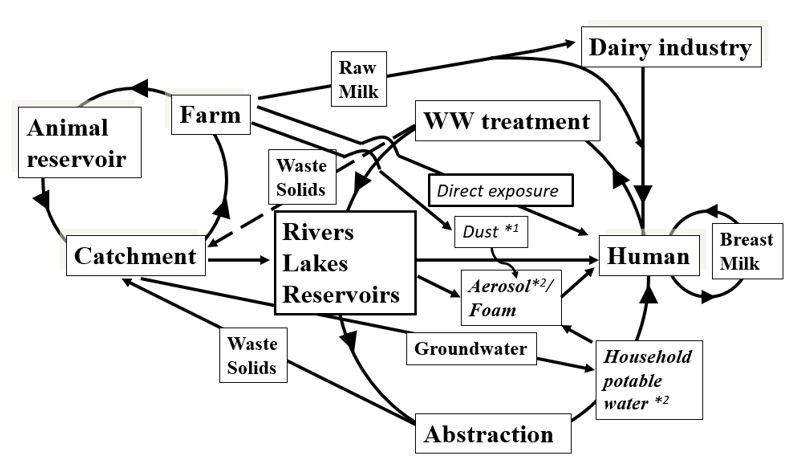
Comment: More about MAP in food and water can be found at this location in our website. Human to human MAP transmission is a potential mode of human infection as shown in the publication from this research team. However, based on the rate of infection of animal populations and the volume of potentially MAP-contaminated feces they deposit in the environment day after day, the most efficient means of human MAP exposure control is resides on farms where producers and veterinarians have all of the necessary knowledge and diagnostic tools to control this infection.
HOW MAP GETS INTO MILK
2019-05-20 18:41:41
Contamination of bulk tank milk MAP can occur through direct shedding into milk by MAP-infected cows, fecal contamination, or introduction of soil and water containing MAP. Humans can be exposed to MAP and many other zoonotic pathogens via raw milk consumption. Additionally, MAP has been shown to survive pasteurization and has been found live at low levels in retail HTST pasteurized milk.
S. Rani, and colleagues reported a computer simulation model to evaluate factors affecting how many MAP bacteria get into milk. Their findings were published in the journal Food Control (vol. 104: 367-376, October 2019). Specifically, they assessed the influence of common hygiene practices, such as washing of udders before milking and the use of milk filters, on the concentration of MAP in bulk tank milk. Their baseline model comprising all hygiene practices on a farm provided an average estimate of 0.76 log CFU/L (at least 5 MAP cells per liter) for the final concentration of MAP in bulk tank milk, with a maximum of 6.70 log CFU/L (over 5 million MAP cells per liter) and a minimum of 0.04 log CFU/L (~1 MAP cell per liter) depending on herd size and the ratio of infection statuses among cows in the herd.
In this model, the average level of fecal contamination of milk in a herd showed the greatest impact on the final MAP concentration per liter in bulk tank milk. In simple terms, hygienic practices at the time of milking the cow is the most important tool to limit MAP contamination of raw milk.
Comment: This conclusion that fecal contamination is the most important means by which MAP gets into raw milk are similar to those of an earlier model published by Nauta & Van der Giessen in the Veterinary record in 1998 (Vet. Rec. 143:293-296). Nauta & Van der Giessen found that the number of cows with clinical Johne’s disease in a herd also was important in estimating the number of MAP in milk. In a related study, Vissers et al. (J. Dairy Sci. 90:3579-3582) evaluated how much dirt (feces, soil and bedding) is found in milk by testing 11 Dutch dairy herds. They reported that the amounts varied widely among farms ranging from 0.7 mg “dirt”/liter of milk to 136 mg “dirt”/ liter of milk with an overall average of 0.59 mg/L.
If MAP-infected dairy herds can eliminate the cows that are heavy shedders of MAP and also maximize the hygiene at the time of milk collection, the raw milk will contain the minimum number of MAP giving pasteurization the best possible chance of killing off those few remaining MAP bacteria. Consumers of raw milk should assume they are consuming MAP unless the herds used as a milk source are 100% test negative for Johne’s disease over multiple years using the most sensitive diagnostic tests, i.e. direct PCR on fecal samples.
To learn more about MAP's ability to resist killing by pasteurization, check out this page on our site under the heading "Biology of MAP"/Resistance.
MAP SURVIVES TEEWURST DURING SAUSAGE PRODUCTION
2019-05-01 13:54:47 Teewurst is a traditional raw spreadable sausage of German origin that can be prepared from pork, beef as well as poultry meat. It has a short ripening process (1–5 days) at high humidity and relatively high moisture content. Even if no additional sugar and starter cultures are added, the final pH value drops below 5.2 which should ensure microbiological safety of the product. However, the results of a study (in press) reported by Alena Lorencova et al. from the Food and Feed Safety Department, Veterinary Research Institute, Brno, Czech Republic in the journal Meat Science demonstrated that the production process was not effective at inactivating MAP. Despite a significant decline during storage, viable MAP cells were present in teewurst for up to 4 weeks after production.
In contrast to teewurst, no viable MAP were recovered during the dry fermented sausage production process. The effect of starter culture (Lactobacillus sp. and Staphylococcus sp.), and lower moisture content, may have played roles in the inhibition of MAP. Starter cultures are necessary for fermentation and contribute to the sausage acidification and color and flavor development.
For more on the many kinds of sausages available worldwide, visit Wikipedia.
Comment: This study was NOT a survey of retail sausages. Rather, it was a laboratory experiment using MAP-spiked meat to prepare sausage and study MAP survival. The study yet again proves that MAP is very hardy. It does not indicate that MAP is in retail teewurst. Prior publications from this research team have documented MAP DNA in retail sausages but found no viable MAP using culture methods.
COMPARISON OF ANALYTICAL METHODS FOR MAP IN MILK
2019-04-27 15:41:43 S. Butot from the Nestlé Institute of Food Safety & Analytical Sciences, Nestlé Research Center, Lausanne, Switzerland together with 9 other colleagues evaluated multiple methods for detection of MAP in milk. Their findings were published in the Open Access journal Frontiers in Microbiology, March 15, 2019.
Three different milk matrices were used in the study: heat-treated milk (four sources), milk powder (five sources), and raw milk (four sources). Considering all matrices, different sensitivities, expressed as the percentage of positives from the total of true positive test portions, were obtained for IS900 qPCR (94%), f57 qPCR (76%), culture (83%), and PMS-phage (40%).
They conclude that qPCR and culture are the most appropriate methods to detect MAP in milk-based matrices according to ISO 16140 methodology. Cultural techniques are considered the gold standard for detection of viable MAP, but qPCR, which is widely used in analytical and surveillance studies, can be considered a suitable and recommendable alternative to cultural methods for screening, if confirmation of MAP’s viability is not requested.
JOHNE'S DISEASE IN EGYPTIAN DAIRY CATTLE
2019-04-15 18:46:40 This research publication is noteworthy because of the paucity of reports on Johne's disease in Egypt. It also is one of the few recent papers to report clinical hematology and chemistry studies in conjunction with diagnostics for Johne's disease.
This study diagnosed Johne's disease in dairy cattle by ELISA. 17 cows were ELISA-positive and had persistent diarrhea. 45 cows were ELISA-positive but clinically normal. 138 cows were ELISA-negative and clinically normal; 15 of these cows were used as controls. Clinical hematology and chemistry parameters were compared for these 3 groups of cattle. The study found significantly lower RBCs (red blood cell numbers), PCV (packed cell volume), total serum protein, serum globulin and serum glucose. No significant differences in oxidative stress markers were found for the 17 clinically affected cows.
Typical colonies of MAP (IS900 PCR-confirmed) were isolated from the fecal samples of clinically affected cows. Phylogenetic analysis of these isolates revealed high similarities with MAP strains from both India and Egypt. This study highlights that MAP infections affect dairy farms in Egypt.
This publication by Ahmed Abdelaal et al., appears in the Solvenian Veterinary Research Journal volume 56 (Suppl 22): 421–431, 2019. This is an Open Access journal. As their policy states: This journal provides immediate open access to its content on the principle that making research freely available to the public supports a greater global exchange of knowledge.
EPIDEMIOLOGY OF PARATUBERCULOSIS
2019-04-09 15:18:50 A review of the epidemiology of paratuberculosis was published in two parts by Dr. Conor McAloon et al. in the April 2019 issue of The Veterinary Journal. Unfortunately the articles are not Open Access, meaning you must pay a fee to gain access to the full article unless your institution subscribes to the journal.
Dr. McAloon works in the Section of Herd Health and Animal Husbandry, School of Veterinary Medicine, University College Dublin, Ireland. He recently received his PhD and is one of the promising new young scientists in the field of paratuberculosis research. The reviews come from his thesis and are published in two parts: Part 1 concerns broader aspects of epidemiology of paratuberculosis, and Part 2 concerns on-farm control of paratuberculosis. Both are excellent and provide the most comprehensive and current information on the subject.
Epidemiology is a topic under each of the main animal species covered on this website. For example this link takes you to the epidemiology of Johne's disease in dairy cattle: Dairy cattle/Epidemiology
POSITION: JOHNE'S DISEASE PROGRAMME MANAGER - IRELAND
2019-03-28 15:32:57 The establishment of the Irish Johne’s Control Programme (IJCP) has been led by AHI in conjunction with industry stakeholders. Following a previous pilot programme, Phase One of the IJCP was launched in late 2017 as a voluntary national programme for the dairy sector. The (IJCP) is a long term programme for the control of Johne’s disease and recognises the value of effective and on-going disease prevention and containment practices to control the infection. The IJCP provides pathways for test-negative and test-positive herds to demonstrate progress towards an improved herd assurance for Johne’s disease, while also improving calf health and biosecurity and providing market assurance.
Further details of the IJCP are available at www.animalhealthireland.ie. Phase Two of the IJCP began in January 2019, with the ambition of achieving a significant level of engagement with dairy herds in the near future. Due to retirement, a vacancy has arisen for a programme manager to oversee the continued development of the IJCP. Reporting directly to the CEO, the successful candidate will have responsibility for all aspects of the IJCP, building on the significant progress made to date.
Link to full position announcement: Johne's Disease Programme Manager-Animal Health Ireland-2019
« Previous 1 … 14 15 16 17 18 19 Next »